The barber sanitation routine between clients is the part new barbers skip first, because it feels slow when the shop gets busy. It is also the part clients watch most closely. This routine shouldn’t get skipped and may be the most important routine a barber can have.
A client sits down in your chair and looks around before you say a word. They see the counter, the cape, the clippers, and the floor. They decide in a few seconds whether you run a clean station, and they decide it without asking you a single question.
That is why I treat sanitation as part of the service. A haircut is the product, but the experience of getting it includes everything the client can see, smell, and feel. A sharp fade on a dirty station is a haircut that may be the last.
This article walks through one routine in three stages: before the first client, between clients, and at close.
Why cleaning is part of the service, not a rule you follow for inspectors
Inspectors visit occasionally. Clients sit in your chair every visit.
If you only clean to pass an inspection, you will clean when you expect someone to look. If you clean because it is part of how you run your business, you clean at every chance, and the work becomes consistent. Consistency is what turns a first-time customer into someone who books again. I wrote more about that shift in how to turn a customer into a client.
There is also a practical side. A clean station is a faster station. Your tools are where you left them, your blades are free of hair, and you are not hunting for a clean towel in the middle of a cut. Cleaning is not time taken away from cutting. It is part of the time a cut takes.
The routine below covers five categories of work:
- Tools: clippers, trimmers, shears, combs, brushes and razors
- Surfaces: the counter, the station, the chair and the mirror
- Hands: yours, washed before every client
- Cape and neck strip: whatever touches the client’s skin and clothing
- Floor: the hair that lands around the chair
Every stage touches some or all of these. The difference between stages is how much you do.
Check your state board first: the rules that override everything here
Your state board’s rules are the final word. Everything in this article is a general routine, and it never replaces what your board requires.
Boards differ on several points that matter to this routine:
- Which disinfectants are approved, and how long a tool must stay in contact with them
- How you store clean tools versus used ones
- Whether neck strips, towels, or both are required, and how they are handled
- What you do with razor blades and other sharps
- What you must post, document, or keep on hand in the shop
I am not going to quote numbers for any of this, because they change from state to state and I do not want you copying a rule that does not apply to you. Find your board’s website, read the sanitation section, and print it or save it where you can reach it. If you are a student, ask your instructor which rules your school teaches and tests against, then confirm them against the board’s own text.
Product labels count as rules too. A disinfectant’s label tells you how to use it, how long it needs to stay wet on a surface, and what it can safely touch. Follow the label. If the label and something in this article disagree, the label wins.
Where my routine goes beyond your board’s minimum, that is a choice you make for your business. Where it falls short of your board’s requirements, add what your board asks for.
Before the first client: setting up the station
The opening routine takes me a few minutes, and it sets the standard for the rest of the day. Here is what I do.
Surfaces first. I wipe down the counter, station top, chair arms, and headrest. Then I clean the mirror and all sinks in the shop. A client looks at that mirror for the whole cut, so a smudged one is the first thing they see.
Wash my hands. Soap and water, every time I start a session. I do not rely on sanitizer as a replacement for washing.
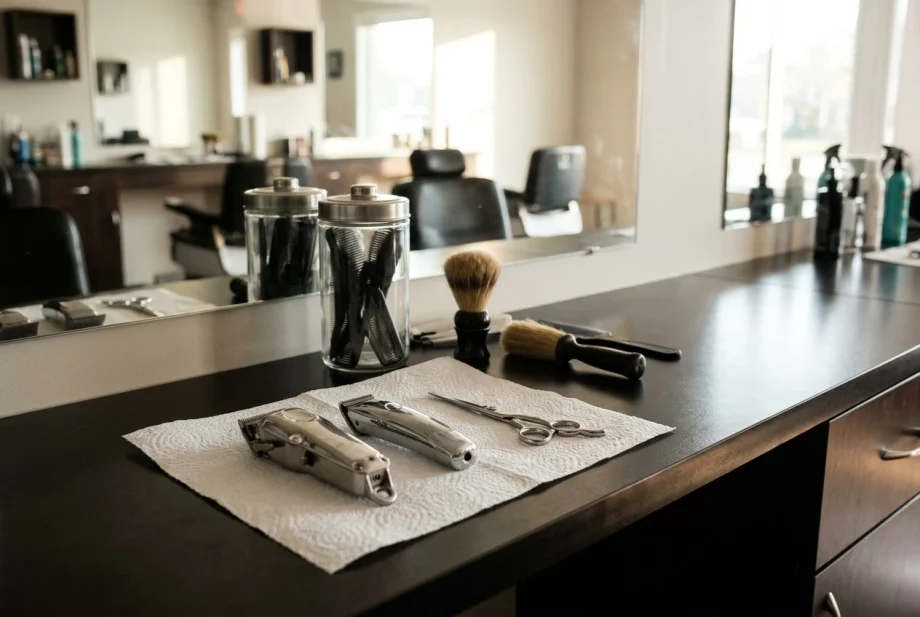
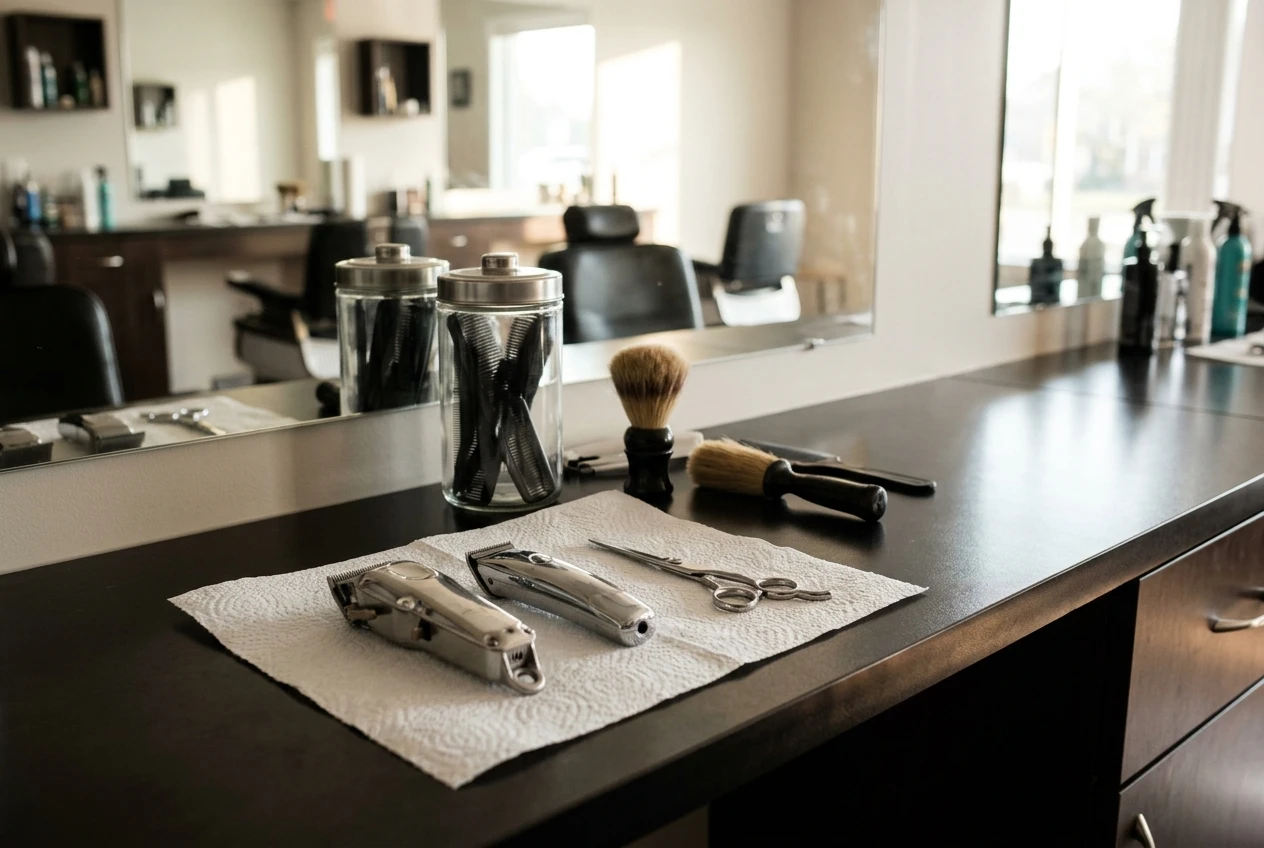
Lay out clean tools. Everything I plan to use comes from the clean storage area. Clippers, trimmers, and shears are placed on a clean disposable paper towel. Combs and brushes are stored in a closed container until ready to use. I check that blades are free of hair and oiled, and that guards are clean.
Check the floor. If hair is left from yesterday, I sweep it before anyone arrives. A first client should never walk in over old clippings.
Clean the bathroom so it’s nice and fresh, ready to greet your customers.
Between clients: the reset I run every single time
This is the core of the routine. I run the same reset after every client, and I do not shorten it because the waiting area is full. A rushed reset costs less time than one client noticing hair on your chair.
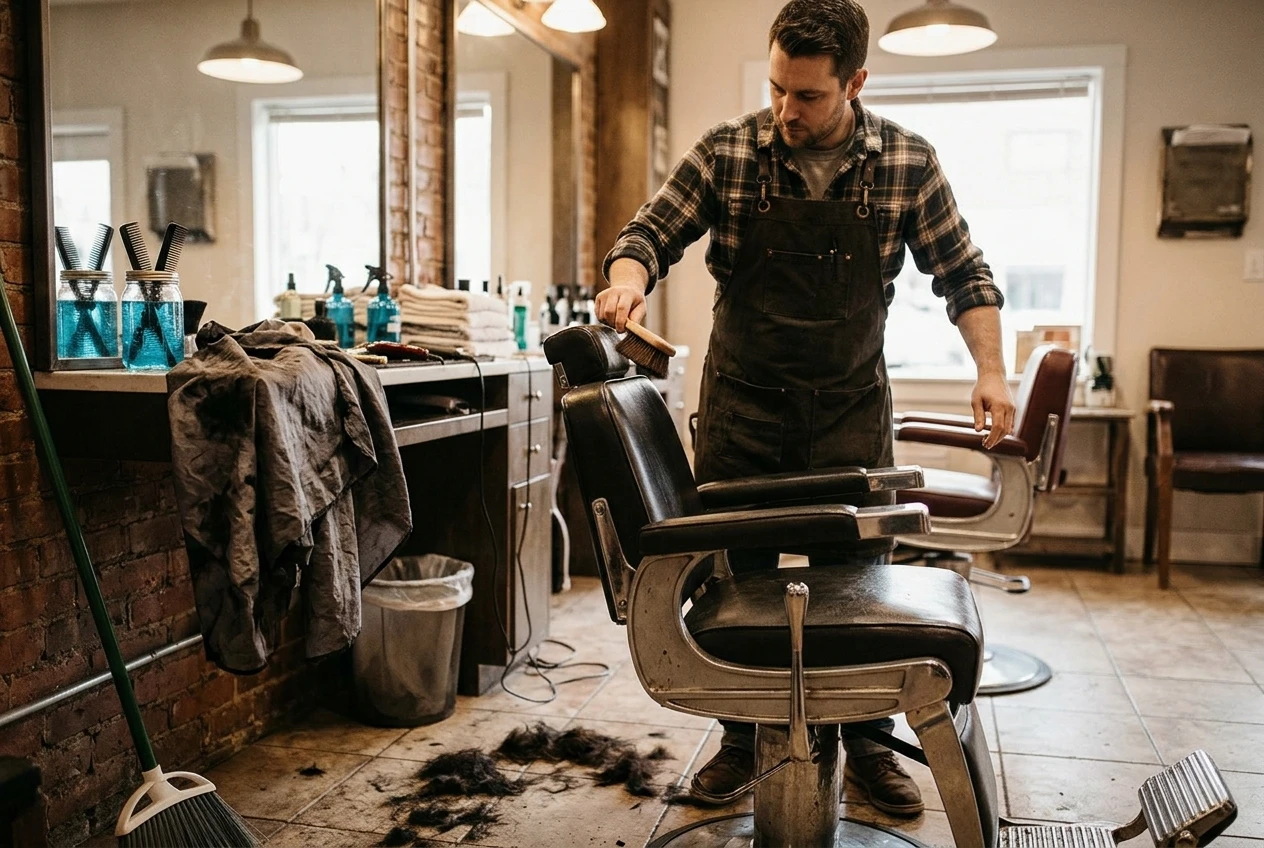
Here is the order I use:
- Remove the cape and neck strip. I take the cape off carefully so hair falls into a waste bin or onto the floor, not onto the client’s clothes. The used neck strip goes in the trash, or a used towel goes in the laundry bin, depending on what your board requires.
- Clear the hair off the chair and the station. I brush down the chair, the headrest, and the counter.
- Put used tools in the used area. Nothing used goes back with clean tools. This separation matters more than any other single habit.
- Clean and disinfect the tools I used. The next section covers clippers, trimmers, and shears in detail.
- Wipe the surfaces. The counter, chair arms, and anything the client or I touched get cleaned with an appropriate product, per its label.
- Sweep the floor around the chair. Hair on the floor spreads through the shop on shoes and gets back onto clean surfaces.
- Wash my hands. Wash with soap and water before I touch the next client.
The whole reset is a sequence, and sequences are easy to repeat. I do not decide what to clean each time. I run the list.
One more point: do the reset where the next client can see it, if the layout allows. Cleaning in view shows the standard without a word of explanation.
How I handle clippers, trimmers and shears in the middle of a busy day
Tools carry the highest risk because they touch skin, and they take the most wear from the cleaning itself. Handle them in a way that protects both the client and the equipment.
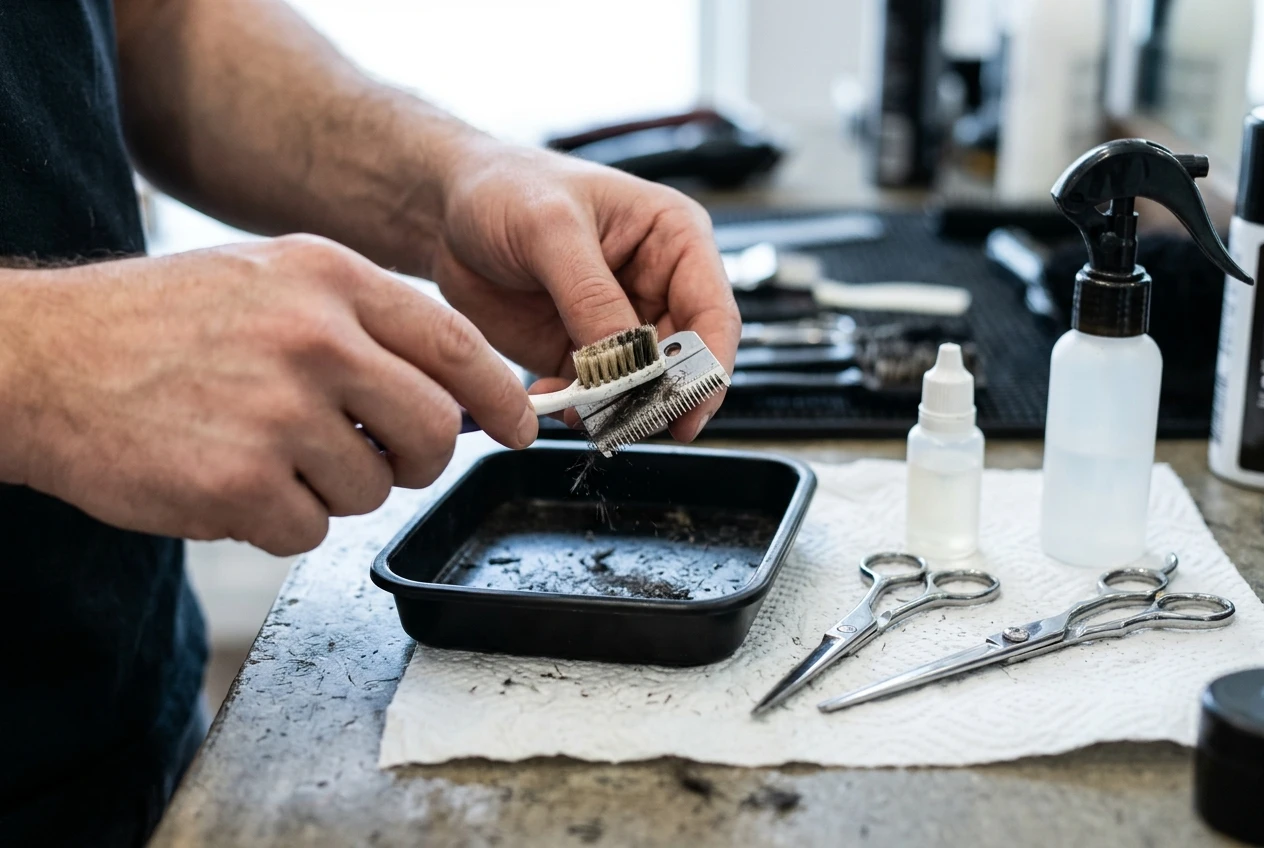
Clippers and trimmers. After each cut, I remove hair from the blades with a brush. Then I disinfect the blades with a product made for clipper blades and used according to its label. Many clipper blades should not be submerged, and that depends on the model, so check the manufacturer’s instructions. A few drops of blade oil afterward keep them running smoothly. Detachable guards get cleaned too.
Shears. I wipe hair off the blades and handles, then disinfect them as the manufacturer and my state board allow. Shears are an expensive tool, and some disinfectants can damage finishes or pivots. Read the care instructions that came with them. The tools I’d buy first post covers what to prioritize if you are still building your kit.
Combs and brushes. Combs get cleaned and disinfected after every client. A comb that touched one head does not touch another until it has been cleaned. Brushes used for the neck get cleaned as well.
Razors and sharps. If your board allows straight razors, blades are single-use in most places and go straight into a sharps container. Check your board’s rule on this one, because it is a safety issue for you and for whoever empties the trash.
Keep enough tools on hand. If your disinfectant needs a certain contact time, you need a second set of combs, or a plan for the wait. Rushing the contact time defeats the purpose of disinfecting. A busy day exposes this problem quickly, so plan for it before the day starts.
I think the most common mistake here is wiping a blade and calling it clean. A wipe removes hair. It does not disinfect. Know which one your product label and your board are asking for at each step.
What I do when the chair is empty, and the shop is quiet
Slow stretches are for maintenance, and they pay off when the next rush arrives. When no one is in the chair, I use that time on the jobs the between-client reset does not reach.
- Deep wipe. I clean the station drawers, and clean and disinfect combs and brushes used from earlier.
- Laundry and trash. Full bins smell, and a pile of used towels looks sloppy. Empty them before they become visible.
- Wipe the waiting area. The seats, the magazine rack, and the door glass count. A client’s first impression starts before they sit down.
Empty time is also when walk-ins arrive. A station that is already clean and stocked means you can take them right away.
Closing down: the end-of-day clean that makes tomorrow easier
The closing routine is the longest one, and I do it completely, even when I am tired. Whatever I skip tonight is waiting for me tomorrow, and it is harder to clean after it has dried.
Tools first. Every tool I used gets brushed, cleaned, and disinfected per its label and my board’s rules. Clippers get oiled. Cordless units are not left on the charger overnight. Then I store everything clean and dry, away from used items.
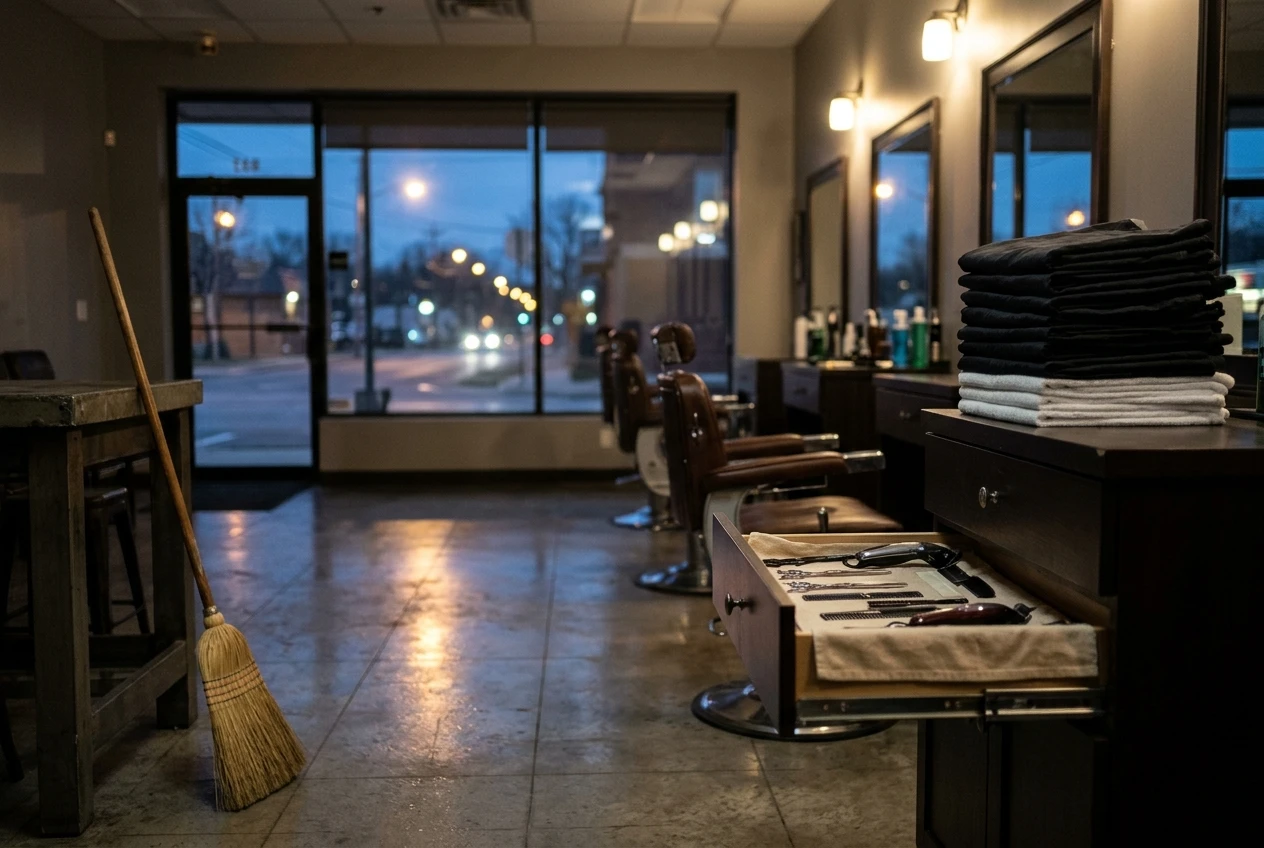
Surfaces. The counter, station, chair, headrest, footrest, and mirror get a full cleaning, not just a wipe. I clean the sink and the handles too.
Laundry. Used capes and towels go into the wash, or into whatever laundry process the board requires. I restock clean ones for the morning.
Trash and sharps. I empty the bins
Floor. I sweep first, then mop if the floor needs it. Hair collects along baseboards and under the chair, so I check those spots.
Wash my hands and check the list. Before leaving, I look over the station once. If I can see anything I would not want a client to see tomorrow, I fix it now.
The payoff is practical. When I come in the next morning, the setup stage takes minutes instead of a rescue job, and the first client of the day gets the same station as the last.
Turning your routine into something clients can see and trust
A clean station that nobody notices earns less than one that clients can read. You do not need to announce anything. You just need to let the work be visible.
- Use the same order every time. Clients see the routine repeat and understand that it is a standard, not a performance for them.
- Clean in view. Put the fresh cape and neck strip on after the client sits down, so they watch it happen.
- Keep clean and used tools separate. Clients understand the difference at a glance when the two areas are clearly apart.
- Wash your hands where they can see you. It takes seconds and answers a question the client may not ask.
- Answer questions plainly. If a client asks how you clean your tools, tell them what you do in a sentence or two. Do not exaggerate, and do not claim anything your board’s rules do not support.
- Post what your board requires. Licenses and notices your state wants displayed belong where clients can see them.
This is part of operating as a business instead of only cutting hair. A repeatable routine, the same every day, is the kind of habit I want to build into the way this community works. It costs very little, and it builds trust in a way advertising cannot.
If you want to see how this fits into the bigger picture of keeping clients, the post on becoming a client’s barber for the long term goes deeper on retention.
Join the community and tell me what your between-client reset looks like. I want to compare notes on what works at a busy chair. And watch for the upcoming ebook on running your chair like a business.