

How to choose the right barber school in Massachusetts without taking on bad debt.
What aspiring barbers should investigate before committing their time, money, and future to a program. Schools should do more than just meet basic requirements; they should offer a robust curriculum that provides comprehensive grooming, styling, and business skills.
Shop for an Education, Not a Certificate
Barbering has grown beyond the image of a trade practiced primarily by older generations. Today, people of all ages are pursuing it as a creative profession, a business opportunity, and a path toward financial independence. However, entering the industry without a proper understanding of the profession can delay your success and make your education more costly.
Learning how to record income, track expenses, prepare for taxes, and build lasting client relationships is just as important as learning how to create a clean fade. The right barber school should prepare you not only to qualify for a professional license but also to use that license to build a sustainable career.
Earning a certificate without developing the knowledge, practical skills, and confidence to reach your full potential may leave you with debt—but without the preparation necessary to succeed. Before choosing a school, begin by understanding exactly what Massachusetts requires.
As of August 2026, an aspiring barber in Massachusetts must:
- Complete a 1,000-hour barbering course at a licensed school.
- Apply for a license.
- Pay the required fees.
- Pass the written theory examination.
Understand the 1000 hr program
Massachusetts requires barber-school programs to provide at least 1,000 hours over no fewer than six months.
Under 240 CMR 8.03(6)(e), the hours are divided as follows:
| Required Subject | Hours |
|---|---|
| Cleaning and disinfection | 80 |
| Shampooing | 10 |
| Haircutting and styling | 400 |
| Hair coloring | 75 |
| Permanent waving | 90 |
| Chemical relaxing | 40 |
| Scalp manipulations and treatments | 15 |
| Shaving | 50 |
| Honing and stropping | 10 |
| Mustaches and beards | 20 |
| Facials | 20 |
| Light therapy | 5 |
| Shop management | 20 |
| Theory | 165 |
| Total required hours | 1,000 |
Students must complete all 1,000 required clock hours. Missing school can delay graduation and may create additional costs. Attendance and make-up-hour policies vary by institution. For example, the school where I work permits up to 100 hours of absence before an additional charge applies. Once a student exceeds 100 missed hours, the school charges $14 for each required make-up hour.
Every prospective student should examine the school’s attendance and make-up-hour policies before signing an enrollment agreement.
Upon program completion the state board must process and approve the exam application, The applicant then receives instructions from PSI for scheduling the written theory examination. Because procedures and fees can change, applicants should follow the current directions supplied by the Board and PSI.
Massachusetts currently allows eligible students enrolled and in good standing in a board-approved apprenticeship program to apply for apprenticeship registration after completing 25 hours of instruction in basic safety, sanitation, and shampooing. The student must be registered before providing services in a licensed establishment and must comply with the Board’s supervision and program requirements. Massachusetts apprenticeship guidance
Licensing & accreditation Related but not identical
- State approval or licensing determines whether the barbering program is authorized to operate and provide qualifying training.
- Accreditation may affect access to federal financial aid and indicates that an outside accrediting organization has evaluated the institution.
State approval and accreditation are related, but they are not the same. A barbering program must be properly licensed and approved by Massachusetts to provide qualifying training.
Accreditation is a separate process conducted by an outside accrediting agency and may affect a school’s eligibility to participate in federal financial-aid programs.
Financial aid does not always mean free money. Ask the school to separate grants and scholarships—which generally do not have to be repaid—from loans that will follow you after graduation.
NACCAS is one accreditor commonly associated with barbering and cosmetology schools. Verify each school through the Massachusetts Board and the U.S. Department of Education rather than relying solely on the school’s advertising.
Be sure to verify both through research.
Massachusetts provides a directory of board-approved and licensed schools.
Calculate the Real Cost Before Enrolling
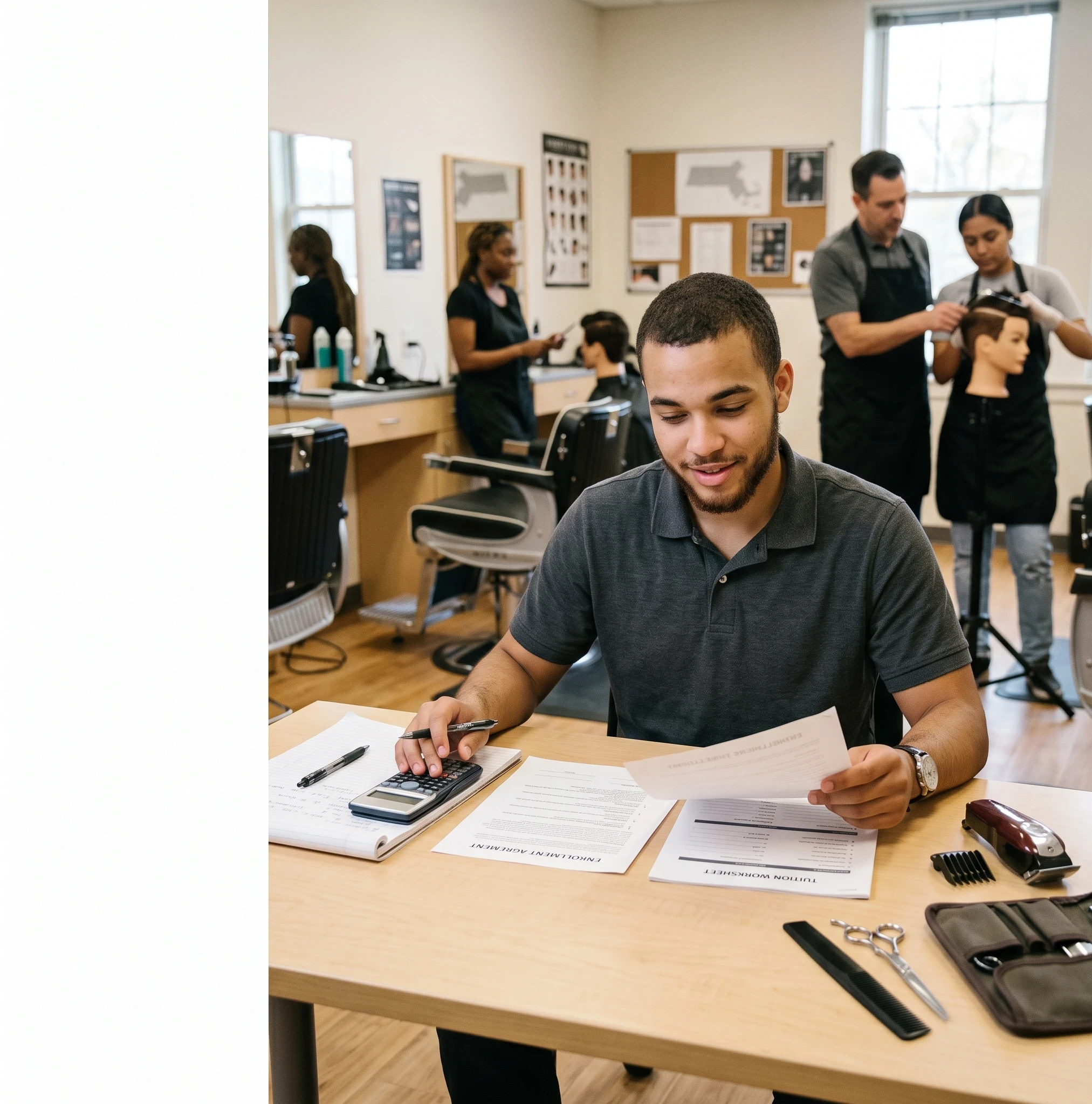
It would be a great idea to request these numbers in writing:
- Tuition
- Registration and application charges
- Books and online learning materials
- Barber kit and replacement tools
- Uniform costs
- Transportation and parking
- Examination and licensing fees
- Charges for missed or make-up hours
- Interest and fees on student loans
- The school’s cancellation and refund policy
- The amount of aid that is a grant versus a loan
- The expected monthly loan payment after graduation
Having this information before you begin can give you an idea of what to expect not only now but when your studies are complete.
Comparing Performance Metrics: What Sets Barber Schools Apart?
Taking a hard look at tuition costs is crucial but don’t base your decision solely on price. Ask key questions to discover just how well you will be prepared.
Graduation rates do not tell the whole story. A high graduation rate may look impressive, but it does not automatically prove that graduates are prepared for the licensing examination or the realities of working in a barbershop. During my 15-plus years as an educator, I have seen students complete programs without fully understanding or retaining the curriculum. Treat graduation rates as one piece of evidence—not the final answer. Do your own due diligence and investigate.
- Licensing-exam pass rates
- Program completion rates
- Graduate employment outcomes
- Student and graduate reviews
- Instructor experience
- Student-to-instructor ratio
- Clinic-floor activity
- Opportunities to observe a class
- Ask to Speak with Recent graduates (at least three)
Ask to sit in on a few classes to check for the quality of education given. Do not merely ask whether the school has licensed instructors. Ask whether enough instructors are regularly available to observe students, correct mistakes, and provide guidance on the clinic floor.
Massachusetts requires two instructors for 25 students or fewer and another instructor or assistant instructor for each additional group of up to 25 students.
Consistent supervision creates an environment in which students can correct mistakes, develop confidence, and strengthen their self-esteem.
This guidance is especially valuable when students feel lost or struggle to understand a technique. Consistent support contributes to a more productive and satisfying learning
Consider the job prospects associated with different schools.
Ask how the school helps eligible students pursue apprenticeship opportunities. Massachusetts allows students enrolled and in good standing in a board-approved apprenticeship program to apply for apprenticeship registration after completing 25 hours of instruction in basic safety, sanitation, and shampooing. Registration is not automatic, and students must be properly registered before providing services in a licensed establishment. Schools with strong industry connections may also help students find participating shops, gain practical experience, and pursue employment after graduation.
Finding employment can be a scary task that many have a hard time taking on. A strong school may help graduates identify shops that match their skills, professional goals, personality, and preferred working environment.
Look for programs that offer innovative curriculum options. Schools that stay up-to-date with the latest trends in barbering and grooming can equip you with modern skills that clients appreciate.
This element of education can impact your earning potential greatly as it adds valuable skills to your toolkit, helping set you up for a successful career.
Location is key
When it comes to picking a location, accessibility is key. What will the daily/monthly cost look like for you to attend. Calculate all of this before signing on that dotted line. A school in a heavily populated area may attract more clinic clients, but location alone does not guarantee meaningful hands-on experience.
Ask how many clients the clinic serves, how services are assigned, and how much supervised repetition the average student receives. Heavy volume cutting can give you more training with repetition that helps you build the confidence needed.
These urban settings often have better public transport links, making it easier to commute if you don’t live nearby. Count the cost of what you will spend during the time you are in school. What Will it cost to park daily? What will the monthly fee for public transportation be?
Ask questions before signing.
Ask how examination preparation is incorporated into the curriculum. Does the school provide structured reviews, practice tests, and sample questions reflecting the subjects and format of the licensing examination?
This is a major step that you are taking to become a licensed professional in the state of Massachusetts. Before signing up to attend don’t be afraid to ask the questions you may need answers to. There is no limit so don’t hold back. Any institution ready to sign you up should be excited at the position you take to understand what you are preparing for.
Will the school offer support when you struggle?
Career counseling, job-placement assistance, tutoring, and mentorship are positive signs, but students should investigate how consistently these services are actually delivered.
Support services are vital when choosing a barber school. This support can be instrumental in building a strong professional network and guiding you through your career path after graduation.
Choose preparation not promises
Barber schools should do more than satisfy the minimum licensing requirements. They should provide thoughtful instruction, consistent supervision, practical preparation, and the business knowledge students need to build sustainable careers.
A promising career is not created by the certificate hanging on the wall. It is built through the education, discipline, repetition, and professional habits developed along the way. Choosing a barber school is a major investment in your future. Investigate carefully, calculate the complete cost, ask difficult questions, and choose preparation over promises.
Barbering is a historic trade built on service, skill, tradition, and community. Entering that brotherhood is an honor—but entering it properly prepared is your responsibility.